

Systematic credit is still a small part of fixed income, but its portfolio role is growing. For credit allocators, it can offer a disciplined and differentiated source of diversification.

- A differentiated return stream for credit allocations
- Broad coverage to identify relative winners and losers
- Systematic selection, portfolio construction and human oversight combined
Systematic investing is well established in equities, but fixed income has been slower to adopt. Within fixed income, systematic investment grade and high yield credit remain a relatively small part of the product universe. eVestment data show that quant strategies accounted for 6.5% of fixed income AuM in 2026, pointing to meaningful growth potential for systematic credit strategies.

Many of the portfolio benefits that have supported systematic equity investing, including discipline, breadth, diversification, customizability and repeatability, also apply to systematic credit. The implementation is different, however. Corporate bond markets are complex, and models need to be tailored to the specific characteristics of credit markets.
From factor ideas to portfolio decisions
The value of systematic credit investing lies in translating fundamental investment ideas and experience into rules that can be applied consistently and efficiently in actual bond portfolios. This differs from relying on simple factor definitions derived from theory alone. A generic value screen, for example, might identify bonds with wider spreads and conclude that they look cheap. A more precise, credit-specific question is whether that spread is attractive once issuer fundamentals, bond characteristics, liquidity, transaction costs and other relevant risks are taken into account.
By defining and historically testing a broad set of decision rules, long-term value-added investment processes can be designed. Combining those rules into a selection model allows large credit universes to be evaluated efficiently each day, while supporting transparent portfolio oversight by linking investment decisions back to the underlying rules.
How systematic credit works in practice
Systematic investing should not be viewed as a black box. In credit, the approach can be understood as systematizing fundamental investment principles into transparent decision rules. It starts by identifying characteristics that can make a bond attractive and then applies those rules consistently across a broad universe.
In practice, the process has two main quantitative engines within the broader investment process. The ranking engine assesses the investable universe and ranks issuers and bonds according to their attractiveness. The portfolio construction engine then converts those rankings into a diversified portfolio while taking account of benchmark alignment, liquidity, risk limits and client-specific constraints.
Why breadth and oversight matter
Breadth and oversight are central to systematic credit. Depending on the mandate, the model can evaluate broad credit universes, from around 1,600 issuers and 5,000 bonds in global high yield to 2,600 issuers and more than 26,000 bonds in global investment grade. Human oversight helps identify issuer-specific risks that may not be fully captured by the model, allowing portfolio managers and credit analysts to challenge the output where downside risk is not adequately reflected.
A different return stream within credit allocations
One of the strongest reasons to consider systematic credit is its ability to complement traditional fundamental credit managers. Many allocators already have exposure to active corporate bond managers. Adding another traditional manager may provide some diversification, but overlap can still exist in investment process, positioning and return drivers. A systematic approach introduces a different decision-making framework within the same asset class.
This difference is visible in the return patterns of Robeco’s systematic and fundamental credit strategies, where excess return correlations have been close to zero across investment grade and high yield.
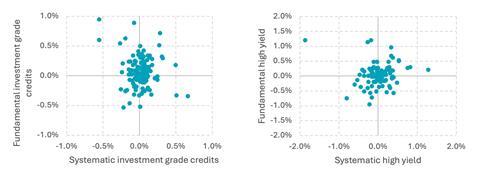
Another source of differentiation is the risk profile. Many traditional active credit managers use a broad toolkit, including active credit beta, curve and duration positions. In Robeco’s systematic credit approach, first-order risks, such as rates and credit beta, are kept close to the benchmark, so that relative returns are driven primarily by bottom-up issuer and bond selection.
This can make systematic credit well suited to enhanced-index-like objectives, where investors seek moderate alpha potential at low tracking error. It can also provide an alternative to passive exposure for investors looking to retain benchmark awareness while incorporating client-specific considerations.
Why experience matters
As more managers apply systematic techniques to credit, experience becomes critical. Successful implementation requires more than a model; it also requires practical knowledge of liquidity, transaction costs and trading across cycles. Robeco Quant Fixed Income combines fundamental fixed income expertise with the data and processing power of Robeco’s broader quantitative platform, helping apply systematic credit across large and complex bond markets.
Systematic credit deserves consideration because it offers allocators something different: a disciplined, evidence-based approach to broad credit markets, a differentiated return stream versus traditional fundamental managers, and the flexibility to create customized portfolios for investment grade, high yield or other specific subsets of the credit market.
See what systematic credit can add to portfolios »
Important information – Capital at risk
This information refers only to general information about Robeco Holding B.V. and/or its related, affiliated and subsidiary companies (“Robeco”), Robeco’s approach, strategies and capabilities. This is a marketing communication solely intended for professional investors, defined as investors qualifying as professional clients, who have requested to be treated as professional clients or who are authorized to receive such information under any applicable laws. Unless otherwise stated, the data and information reported is sourced from Robeco, is, to the best knowledge of Robeco, accurate at the time of publication and comes without any warranties of any kind. Any opinion expressed is solely Robeco’s opinion, it is not a factual statement, and is subject to change, and in no way constitutes investment advice. This document is intended only to provide an overview of Robeco’s approach and strategies. It is not a substitute for a prospectus or any other legal document concerning any specific financial instrument. The data, information, and opinions contained herein do not constitute and, under no circumstances, may be construed as an offer or an invitation or a recommendation to make investments or divestments or a solicitation to buy, sell, hold or subscribe for financial instruments or as financial, legal, tax, or investment research advice or as an invitation or to make any other use of it. All rights relating to the information in this document are and will remain the property of Robeco. This document may not be copied or used with the public. No part of this document may be reproduced or published in any form or by any means without Robeco’s prior written permission. Robeco Institutional Asset Management B.V. has a license as manager of UCITS and AIFs of the Netherlands Authority for the Financial Markets in Amsterdam.
Parts of the marketing material may involve the use of AI-assisted tools to support the creation and review of marketing materials. These tools are designed to help ensure greater consistency and efficiency. All outcomes are reviewed by human evaluators.
Australia
This document is distributed in Australia by Robeco Hong Kong Limited (“RHK”) (ARBN 156 512 659). RHK is exempt from the requirement to hold an Australian financial services license under section 911A(2)(ep) of the Corporations Act 2001 (Cth) in respect of the financial services it provides. RHK may only provide financial services to wholesale clients under that exemption. RHK is regulated by the Securities and Futures Commission under the laws of Hong Kong, which may differ from Australian laws. This document is distributed only to “wholesale clients” within the meaning of the Corporations Act 2001 (Cth). It is not intended for distribution or dissemination, directly or indirectly, to any other class of persons. This document is not intended for public distribution in Australia.
Hong Kong
This document is issued by Robeco Hong Kong Limited, which is regulated by the Hong Kong Securities and Futures Commission (“SFC”). The contents of this document have not been reviewed by the SFC. Investment involves risks. This information does not constitute an offer to sell, a solicitation of an offer to buy, or a recommendation for any security.
New Zealand
In New Zealand, this document is only available to “wholesale investors” within the meaning of clause 3(2) of Schedule 1 of the Financial Markets Conduct Act 2013 (‘FMCA’). This document is issued by Robeco Hong Kong Limited which does not have a place of business in New Zealand.
Singapore
This information is for informational purposes only and should not be construed as an offer to sell or an invitation to buy any securities or products, nor as investment advice or recommendation. The contents of this document have not been reviewed by the Monetary Authority of Singapore (“MAS”). Robeco Singapore Private Limited holds a capital markets services licence for fund management issued by the MAS and is subject to certain clientele restrictions under such licence. An investment will involve a high degree of risk, and you should consider carefully whether an investment is suitable for you.
Switzerland
Robeco Switzerland Ltd is licensed by the Swiss Financial Market Supervisory Authority FINMA as a manager of collective assets.
United Kingdom
This information is provided by Robeco Institutional Asset Management UK Limited, 30 Fenchurch Street, Part Level 8, London EC3M 3BD, registered in England no.15362605. Robeco Institutional Asset Management UK Limited is authorised and regulated by the Financial Conduct Authority (FCA – Reference No: 1007814).
US
This document may be distributed in the US by Robeco Institutional Asset Management US, Inc. (“Robeco US”), an investment adviser registered with the US Securities and Exchange Commission (SEC). Such registration should not be interpreted as an endorsement or approval of Robeco US by the SEC. Robeco B.V. is considered “participating affiliate” and some of their employees are “associated persons” of Robeco US as per relevant SEC no-action guidance. Employees identified as associated persons of Robeco US perform activities directly or indirectly related to the investment advisory services provided by Robeco US. In those situations, these individuals are deemed to be acting on behalf of Robeco US. SEC regulations are applicable only to clients, prospects and investors of Robeco US. Robeco US is wholly owned subsidiary of ORIX Corporation Europe N.V. (“ORIX”), a Dutch Investment Management Firm located in Rotterdam, the Netherlands. Robeco US is located at 90 Park Avenue, 21st Floor, New York, NY 10016.
© Q2/2026 Robeco