
All Factor Investing/Smart Beta articles
-
 White papers
Have Rate Hikes Tipped the Scales Toward Value Equities?
In the AI-led markets of recent years, companies with distant profit potential have been favored. But higher interest rates could change the equation and create a new advantage for value stocks, whose businesses tend to have more visible cash flows in the shorter term.
-
 White papers
Index investing is not index administration
‘Index 2.0’ allows investors to define what they own and why. We examine a route to index customisation that aims to keep the discipline of an index while minimising the administrative frictions of an index provider.
-
 White papers
Old ideas, new applications: the evolution of index and rules-based investing
In this article we explain how ideas with roots in the 1970s – from factor investing to the foundations of UBS HOLT – are being applied to modern index and rules-based strategies through new data, research and portfolio construction techniques.
-
 White papers
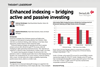
Enhanced indexing – bridging active and passive investing
Investment strategies that sit between passive and highly active management have gained increasing attention from investors. Often referred to as enhanced indexing, active indexing or smart beta, these approaches combine features of both investment styles.
-
 White papers
Systematic fixed income: Bringing diversification benefits to credit portfolios
Systematic credit is still a small part of fixed income, but its portfolio role is growing. For credit allocators, it can offer a disciplined and differentiated source of diversification.
-
 Podcast
Focus on the broader EM opportunity – not just the tech titans
Emerging market equities have staged a powerful comeback, led by AI-related companies in Korea and Taiwan. However, the bigger long-term EM opportunity favors a systematic, broad-universe approach.
-
 White papers
Why market structure rewards active management in local currency EMD
Local currency emerging market debt (EMD) has matured into one of the most diverse opportunity sets in global fixed income. Issuance has grown, liquidity has deepened, yield curves have developed, and the ownership base has broadened across domestic and international investors. For many emerging economies, a functioning local bond market and credible monetary policy are now signals of economic development rather than aspirations.
-
 White papers
Emerging markets: One index, different destinies
For three decades, allocators have bought emerging markets on a narrative: faster growth, better demographics, and deeper integration into world trade. It was a convenient story, and it built a large asset class. However, treating EM as a monolith disguises the complexity inherent in investing in such a diverse universe and, in our view, limits your performance potential.
-
 White papers
Agentic AI for Financial Applications: A Comprehensive Survey
Language models have given rise to agentic AI: autonomous systems that pursue high-level goals through tool use, orchestration, and adaptation. Although prior surveys treat financial applications, agent architectures, and fine-tuning methods in isolation, this review integrates the full agentic stack.
-
 White papers
Hiring a Systematic Bond Manager? Seven Questions for Candidates
Systematic bond investing needs specialist skills and resources. Has your manager got what it takes?
-
 White papers
Why value can never go out of style in high yield
There is an unappealing paradox at the heart of investing in line with a bond index: the more indebted an issuer, the larger its place in the benchmark. The largest 20% of issuers account for close to 60% of the ICE BofA Global High Yield Index, for instance.¹
-
 White papers
The Full Picture: How Factors Work Together in Systematic Fixed Income
Systematic fixed-income investing is an active approach that aims to beat market returns by identifying and harnessing the factors that drive bond performance.
-
 White papers
Innovating for Better DC Outcomes: The Evolution of Royal London Asset Management’s Equity Tilt Solutions
In 2019, Royal London Asset Management and our parent group, Royal London, identified the potential to develop the equity elements of its key propositions with the aim of further improving customer outcomes. The main beneficiaries of any development would be investors in the flagship governed range of risk‑rated multi‑asset portfolios, including the workplace default investment.
-
 White papers
The Great Rotation: Why the Recent Value Rally Is Ready to Resume
Barring a protracted stalemate in Iran, we believe value stocks are poised to resume their pre-conflict rally.
-
 Podcast
AI: Transforming quantitative portfolio management
Artificial intelligence and machine learning are contributing increasingly to the process of identifying stock investment opportunities and managing portfolio risk, particularly when it comes to quantitative equity strategies that use mathematical models, algorithms and vast datasets to identify and capture the best ideas.
-
 White papers
MDT: How we seek to enhance our alpha model
Elegance is an essential part of the process.
-
 White papers
Systematic Active Fixed Income Turns 2
Systematic Active Fixed Income’s (SAFI) first two years reinforce the power of our investment process also demonstrating how SAFI can complement fundamental active managers given low alpha correlations. Read more about the 2-year SAFI experience at State Street.
-
 Video
VideoHow has quant investing evolved over time?
In this short video, Daniel Mahr, Head of MDT Group, explores how quantitative investing has evolved – from early factor models to today’s data‑rich, machine‑learning‑driven strategies.
-
 White papers
Macro-factors revisited: an evolving approach to portfolio resilience
This paper revisits and builds upon our 2024 research on macro-factor exposures across public and private markets, with a particular focus on private infrastructure.
-
 White papers
How Beta Investors Keep Alpha Under Control
Active ETFs are redefining the parameters of modern portfolio construction, offering solutions to the challenges faced by institutional investors. While it is easy to get lost in the rapidly expanding array of active ETFs, when investing in them European institutional investors have remained firmly anchored near core allocations around established benchmarks such as MSCI World and Europe.