
All Investors articles – Page 3
-
 White papers
The rise of AI-washing: what investors need to know
Artificial intelligence (“Al”) has become ubiquitous in today’s technological landscape. Whether it’s running algorithms that recommend streaming content, driving autonomous vehicles that navigate traffic, or even simply sorting an e-mail inbox, Al is undoubtedly a powerful tool that promises efficiency, scalability, and competitive advantage for modern technology companies. As a result, companies that focus on the enhancement of Al capabilities often garner heightened attention from investors seeking to capitalize on innovative new technologies.
-
 Video
VideoGemcast Episode 7: The emerging critical mineral challenge
In episode 7 of Gemcast, Viloshan Govender, Portfolio Manager at Gemcorp Capital, discusses the huge growth in demand for critical minerals, the key drivers behind this and the crucial role the emerging world has to play in meeting this. Drawing on his career journey he sheds light on the challenges investors face and how Gemcorp Capital is using its expertise to unleash this opportunity.
-
 White papers
Playing the Long Game Amid Risk Market Turbulence
Among the factors driving equity market swings recently and since summer, monetary policy – and very recently, the fear of a misstep in monetary policy – has been particularly powerful.
-
 White papers
Looking past the chaos: the time for European real estate debt
The global commercial real estate market has undergone a profound transformation since mid-2022, with rising interest rates and macroeconomic uncertainty driving a significant repricing of assets—capital values have corrected by approximately 20–25% across Europe, creating one of the most attractive entry points for real estate debt investment in over a decade.
-
 White papers
Q4 2025 Global Trends and Tactics
Global private real estate markets are experiencing a significant turnaround, with values climbing for five consecutive quarters and total returns turning positive across all 21 tracked countries in Q2 2025, marking a decisive end to the 2022-2024 correction. Transaction volumes have surged to $739 billion over the trailing year—a 19% year-over-year increase—while real estate debt markets present compelling opportunities as lending risk diminishes, though tighter pricing reflects intensifying competition for quality assets. Read the full report to explore the data driving this global recovery and understand the investment landscape ahead.
-
 White papers
From skepticism to settlements: how global class actions are delivering for investors
For institutional investors, the idea of recovering losses through securities litigation outside the United States has long carried a sense of uncertainty. The United States, with its robust class action system and the opportunity for investors to sit on the sidelines of litigation while still benefiting from recoveries, make the United States the most active jurisdiction relied upon by investors to compensate for corporate and accounting irregularities as well as misstatements. For decades, with billions in recoveries available to investors every year, there was no need for investors to seek recovery outside of the United States.
-
 White papers
Investor protection thirty years after the PSLRA: a creeping immunity for corporate misconduct
Since the beginning of 2025, U.S. policymakers have been systematically rolling back investors ability to challenge corporate misconduct. The SEC has purported to limit institutional investors’ ability to propose matters for a shareholder vote, to engage directly with management on issues of concern, and even to access the courts to seek relief for fraud. In the race to attract more corporations to their jurisdictions, states such as Delaware, Texas, and Nevada have dramatically limited shareholders’ rights to govern corporations organized there.
-
 White papers
What makes a Qualifying Money Market Fund unique?
This document outlines what makes a fund ‘qualifying’ and why it’s worth considering a short-term sterling prime fund over bank deposits.
-
 White papers
The Quality Quandary in European Equities
How can investors in high-quality companies overcome this year’s performance headwinds?
-
 White papers
MIM Q3 2025 Investment Grade Corporate Market Review and Outlook
MetLife Investment Management’s investment grade corporate credit platform delivered strong results in Q3 2025, supported by resilient investor demand, renewed appetite for duration and the Federal Reserve’s pivot toward rate cuts. Quarterly issuance reached $397 billion — 23% above the four-year average — with September’s $214 billion total ...
-
 White papers
Selectivity drives outperformance in Europe
The analysis emphasizes that in the current European real-estate climate, careful asset selection and opportunistic positioning are key — outperformers are likely to emerge not by broad market exposure, but through selective, disciplined investment strategies.
-
 Video
VideoChina Equity Q4 2025 report: The rewards of a disciplined and dynamic approach
When we launched our China Equity Strategy in July 2022 it was during a tough period for the asset class. However, we did not just see risks, we saw opportunities. Despite various headwinds, we saw enduring potential in a market that remains one of the most dynamic in the world – and that conviction has been rewarded.
-
 White papers
Private Markets 2026 Outlook
Learn the views of our private markets experts. Mobilising new sources of capital and democratising private markets.
-
 White papers
Equities 2026 Outlook
Learn the views of our equities CIO and key portfolio managers. One big, beautiful world – or a correction ahead?
-
 White papers
The Federated Hermes 2026 Outlook
For the Federated Hermes 2026 outlooks series, we brought in our three CIOs – in liquidity, fixed income and equities and our head of private markets – as well as key portfolio managers across the business for their sector-specific views.
-
 White papers
How Banks and Private Markets Are Redefining Credit
The U.S. banking industry is entering a new era in which regulated banks and private lenders are increasingly intertwined. We believe this trend will continue to open attractive opportunities for dynamic allocation across the credit spectrum.
-
 White papers
September jobs report: Finally, some data
The report provides updated labour-market data (non-farm payrolls etc.) reflecting underlying economic and employment trends in the U.S., which have broader implications for CRE demand and overall real-estate fundamentals via consumption, income and employment stability
-
 White papers
Fall 2025 Private Markets Outlook: In an Inflection Year, Selection Matters More
Private markets appear to be nearing an inflection point, presenting both new opportunities and risks. We believe that’s when manager selection matters most.
-
 White papers
‘Controlled Disorder’ with room for accidents
We will remain in an environment of heightened geopolitical risk in 2026. This is a result of various megatrends still playing out, including: the transition to multipolarity, economic warfare, US–China competition, as well as the arms and technology race underway. The war in Ukraine and tensions in the Middle East are additional factors. As geopolitical risk remains elevated, so is the likelihood of downside surprises and tensions flaring up. However, geopolitics also defines trends that bring opportunities. While uncertainty will prevail, geopolitics in 2026 will bring both upsides and downsides for investors.
-
 White papers
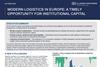
Modern Logistics In Europe: A Timely Opportunity For Institutional Capital
As the new European real estate cycle takes shape, we continue to see logistics as one of the more attractive investment propositions, underpinned by three pillars: