The active-passive debate has long been framed as a contest between competing investment philosophies. In equities, the distinction is familiar: passive delivers low-cost market exposure, while active promises the possibility of outperformance through stock selection. Yet few asset classes expose the limitations of this binary as clearly as high yield credit.
Passive investing has solved a genuine problem in credit markets. Historically, high yield investing required trading infrastructure, credit research capacity and tolerance for idiosyncratic risk. By June 2026, global assets in passive fixed income ETFs had approached USD 3 trillion, underscoring the extent to which investors have embraced the model. The logic is straightforward. High yield returns are inherently asymmetric: a single default can materially impair returns, whereas the upside of one successful issuer is capped. Broad diversification therefore matters. From a portfolio construction perspective, exposure across hundreds of issuers can absorb isolated credit events far more effectively than a concentrated portfolio of 40 or 50 bonds, at times even where the latter is supported by extensive bottom-up research.
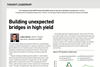
In fact, performance evidence helps explain why passive high yield should not be dismissed too quickly. According to the latest SPIVA scorecard, a majority of active US high yield managers underperformed the iBoxx US High Yield benchmark across multiple time horizons (Figure 1). While active management undoubtedly creates winners, consistently outperforming broad high yield benchmarks remains challenging.
The liquidity argument is equally important. Fixed income ETFs have not simply created a lower-cost wrapper around existing bond exposures; they have significantly influenced how many investors access, price and trade fixed income markets. Today, it is widely recognised that the inclusion of bonds in ETF creation and redemption baskets can enhance liquidity in both high yield and investment-grade markets, with the benefits persisting across both calm and more volatile market environments.
Read the full ‘Thought Leadership’ article at the link below
Supporting documents
Click link to download and view these filesBuilding unexpected bridges in high yield
PDF, Size 0.18 mb