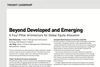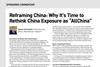
Country classifications are often presented as labels attached to markets. In practice, they are de facto allocation decisions. They determine which countries enter a mandate, where risk is reported and how capital is allocated amongst developed and emerging markets.
“Global” Has Become Primarily a US Allocation
Those decisions matter more as market structure and geopolitics diverge. As of 30 June 2026, US equities represented 66% of the MarketVector™ Investable Global Index (MVIGE). This is not a flaw in market-cap weighting methodology, but the reality that a single market with an extreme weight can produce less diversification than the word “global” may imply.
A global equity benchmark can remain representative of the market while becoming less useful as a neutral starting point for investors who want direct control over country risk.
Market-capitalisation weighting answers an important question: where does the aggregate investable equity value stand today? It does not answer a different question: how much exposure should a long-term investor assign to a single country, currency or regulatory regime? Treating market representation as portfolio neutrality can obscure that distinction. Separating the US does not reject the market portfolio. It allows investors to choose it intentionally.
Developed-Market Exposure carries China-Linked Risk
Another quandary is currently present inside the developed-market label is Hong Kong. Hong Kong continues to offer sophisticated trading, custody and settlement infrastructure. At the same time, its legal, political and economic links with mainland China have deepened. A classification based mainly on market mechanics may therefore understate the jurisdictional risk perceived by some investors.
Security-level mechanics are important. Mainland-incorporated companies listed in Hong Kong are generally assigned to China already. Less visible issue concerns locally-incorporated Hong Kong companies. Their listings may retain developed-market characteristics while their operating environment is increasingly connected to mainland Chinese policy outcomes.
A modern global benchmark should do two things at once: preserve investability and make its most consequential allocation choices visible.
Read the full ‘Thought Leadership’ article at the link below
Supporting documents
Click link to download and view these filesBeyond Developed and Emerging
PDF, Size 0.13 mb