Content (219)
-
 White papers
Ripping up the rule book: politics, power and portfolios in 2026
Geopolitics has long been treated as an episodic risk, something that flares up, disrupts markets briefly and then fades into the background. Yet recent years have challenged that assumption. As power dynamics shift and long-standing beliefs about global stability erode, investors face a more complex environment, in which geopolitical, political and fiscal risks are no longer easily separated.
-
 White papers
Alternative credit insights: Diversify globally, derisk locally
As markets are increasingly influenced by geopolitics, economic uncertainty and evolving credit markets, opportunity lies beyond borders. Alternative credit continues to offer resilient income potential, but successful outcomes depend on thoughtful diversification and disciplined risk management. By pairing global reach with local insights, investors can build portfolios designed to withstand volatility, capture durable yield and support long-term objectives.
-
 White papers
Multi-asset credit investing: A quantitative framework
The credit universe has expanded far beyond government bonds and investment-grade corporates. Today’s investors navigate high yield, leveraged loans, securitized assets, emerging markets debt and private credit, requiring a disciplined approach to capture value across complexity. Discover how a quantitative framework integrating capital market assumptions, risk modeling and optimization can help institutional investors construct portfolios tailored to specific objectives, from matching insurance liabilities to meeting pension obligations.
-
 White papers
2026 Fixed income outlook: Structural shifts create strategic opportunities
The global fixed income landscape is becoming more differentiated and policy-driven. Fiscal policy is reshaping yield curves, while the narrowing gap between developed and emerging markets demands a fresh approach to credit assessment. Despite tight valuations in traditional credit, the macro environment remains constructive with improving growth, moderating inflation and healthy corporate balance sheets. Discover where we’re finding the most attractive risk-adjusted opportunities across securitized credit, municipals, leveraged finance and beyond.
-
 White papers
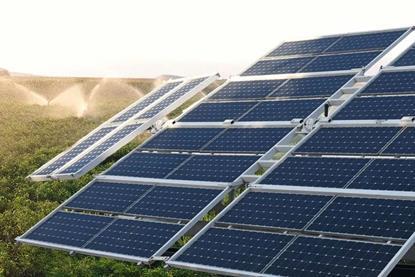
2024-2025 Private equity impact report: Accelerating solutions for a world in transition
Climate change and inequality remain deeply interconnected challenges. At Nuveen Private Equity Impact, we’re backing growth-oriented, lower-middle market companies driving an inclusive transition to a low-carbon economy, where impact and performance are directly aligned. Explore our latest report for insights on new investments across energy efficiency and circular economy solutions, enhanced ESG measurement, industry partnerships, and portfolio case studies showcasing real-world impact.
-
 White papers
The Fed delivers a rate cut with a caveat
The Federal Reserve cut rates by 25 basis points but signaled a more cautious path ahead, projecting just one cut in 2025. The policy statement leaned hawkish with upgraded growth forecasts, while Chair Powell maintained a neutral tone. What does this mean for your portfolio? Discover where we see the biggest potential in today’s rate environment.
-
 White papers
Above and below the radar: Five themes for 2026
The outlook for growth, inflation and rates remains unsettled, but compelling opportunities exist. From U.S. large caps and private credit continuing their momentum, to potential turnarounds in municipals, real estate and private equity. Discover five investment themes to watch in 2026, including less-discovered areas like alternative credit markets and second-derivative AI plays.
-
 White papers
U.S. markets for ecosystem restoration: Enabling investment in nature-based solutions
With over $2.1 trillion of U.S. GDP tied to nature-dependent sectors, investors face significant risks from nature loss. Discover how ecosystem restoration markets offer an opportunity to generate financial returns while delivering quantifiable environmental benefits through one of the world’s largest environmental credit markets.
-
 White papers
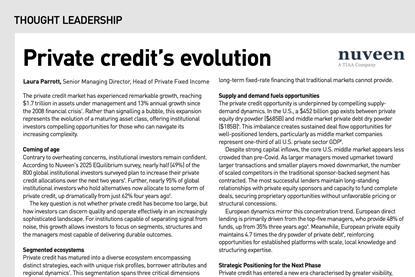
Private credit’s evolution
The private credit market has experienced remarkable growth, reaching $1.7 trillion in assets under management and 13% annual growth since the 2008 financial crisis. Rather than signalling a bubble, this expansion represents the evolution of a maturing asset class, offering institutional investors compelling opportunities for those who can navigate its increasing complexity.
-
 White papers
Looking past the chaos: the time for European real estate debt
The global commercial real estate market has undergone a profound transformation since mid-2022, with rising interest rates and macroeconomic uncertainty driving a significant repricing of assets—capital values have corrected by approximately 20–25% across Europe, creating one of the most attractive entry points for real estate debt investment in over a decade.
-
 White papers
Q4 2025 Global Trends and Tactics
Global private real estate markets are experiencing a significant turnaround, with values climbing for five consecutive quarters and total returns turning positive across all 21 tracked countries in Q2 2025, marking a decisive end to the 2022-2024 correction. Transaction volumes have surged to $739 billion over the trailing year—a 19% year-over-year increase—while real estate debt markets present compelling opportunities as lending risk diminishes, though tighter pricing reflects intensifying competition for quality assets. Read the full report to explore the data driving this global recovery and understand the investment landscape ahead.
-
 White papers
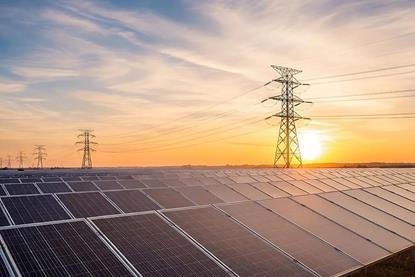
Power in Transition: Charting a path to a sustainable energy future through private equity investments
Power demand is accelerating from data center growth, electrification and population increases, while supply becomes more volatile and unpredictable due to extreme weather and variable renewable generation. The widening gap between demand and supply is driving more frequent outages and higher power prices, pressuring household and business budgets while threatening essential services. Bridging this gap requires significant investment on both supply and demand sides, creating opportunities to build a more resilient, affordable and sustainable energy system.