
All Asset allocation articles
-
 White papers
Markets weigh rising yields and AI exuberance
Market volatility has increased in recent weeks, particularly in bond markets. The MOVE index, a measure of expected volatility in US Treasuries, has been rising significantly, decoupling from the VIX equity volatility indicator in an unusual move. This is significantly different from the March volatility spike that affected both markets at the start of the Iran war.
-
 Asset Manager News
Coöperatie VGZ commits €25 Million to Van Lanschot Kempen’s SDG Farmland Fund
Coöperatie VGZ has made an initial commitment of €25 million to Van Lanschot Kempen Investment Management’s Farmland Fund. With this investment, VGZ has chosen a globally diversified farmland strategy that combines regenerative agriculture with portfolio diversification and long-term value creation. The commitment represents VGZ’s inaugural investment into regenerative agriculture as part of its mission to promote biodiversity and healthy food.
-
 White papers
Global Investment Views - October 2026
In September, global bond markets came under pressure amid inflation concerns and hawkish shifts by central banks, while equity markets remained relatively calm, supported by strong economic data and earnings, alongside renewed optimism around AI.
-
 White papers
Latin America rising as a diversifier
“In a market shaped by AI, energy price uncertainty and re-routing, Latin American equities can offer diversification supported by attractive valuations and improving policy dynamics”
-
 White papers
EM Debt: The Case for a Blended Approach
The EM debt universe is larger, more diverse and higher quality than many investors perceive, offering compelling opportunities today. Given the uncertainties ahead, investors may benefit from taking a blended approach.
-
 White papers
The New Era of Income Investing
How to design income portfolios beyond traditional stocks and bonds.
-
 White papers
Investment View for Q4: Liquidity is confidence
‘Investment View’ provides our quarterly macro & market outlook and investment recommendations
-
 White papers
Core-Satellite Fixed Income: Evolving from concept to practice
The Core-Satellite approach offers investors a flexible framework for tailoring their fixed income exposure, taking full advantage of the expanding breadth of fixed income building blocks.
-
 White papers
The road ahead for central banks
In a low-trust world that is becoming increasingly predatory, investors should expect supply shocks to become a new norm and the distribution of economic gains to stay uneven. Another result of the global order fragmenting is the rise of fiercer competition between countries. However, this competition is no longer limited to trade, tech, industrial leadership or energy security; it is instead being shaped by a relentless search for capital at the public and private level.
-
 Video
VideoConnecting the Dots: A Holistic Approach for Insurers
For insurance investors, a holistic approach to asset allocation is more important than ever.
-
 White papers
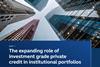
The expanding role of investment grade private credit in institutional portfolios
U.S. investment grade private corporate credit, debt issued directly to a small group of institutional lenders rather than sold on the public bond market, is seeing increased interest from asset allocators. The market predates the below-investment grade direct lending market by decades, driven largely by life insurers as a core fixed income allocation.
-
 White papers
Relative Value & Tactical Asset Allocation Q4 2026
Resilient growth, persistent inflation, evolving monetary policy, and geopolitical uncertainty are expected to shape markets heading into 2027. AI-related investment remains an important growth driver, while rate volatility may create opportunities for selective investors.
-
 White papers
Home is not a guaranteed hedge
Having spent more than two decades in asset management and private wealth, I have watched investors become more nuanced in the way they think about risk. What once appeared prudent can start to look less safe when the world changes around it. Today, that is increasingly true of portfolios that remain concentrated close to home.
-
 White papers
Rethinking emerging markets: diversification and growth opportunities in equities and fixed income
Growing global uncertainty around company valuations, monetary policy and business cycles is prompting investors to rethink their asset-allocation strategies – and emerging markets (EM) are ideally placed to benefit. Across EM, a number of factors are combining to create compelling diversification opportunities in both equities and fixed income.
-
 White papers
Emerging Markets, Reframed
Within a few years, the United States could be spending as much of its budget servicing debt as a median high-yield emerging market country. It is a stunning role reversal — and a useful starting point for rethinking the case for emerging markets.
-
 White papers
What unicorns reveal about future investment risk
Private market investments are now a mainstay of institutional portfolios. Yet while allocations have grown, the information available to investors has not kept pace.
-
 White papers
Global yields surge
“We are in a regime of higher yields for longer across the globe. Bond volatility is likely to stay higher than in the past decade, but yields are becoming increasingly attractive.”
-
 White papers
Beyond Developed and Emerging
Country classifications are often presented as labels attached to markets. In practice, they are de facto allocation decisions. They determine which countries enter a mandate, where risk is reported and how capital is allocated amongst developed and emerging markets.
-
 White papers
Redrawing the map of sovereign investing
For much of the past two decades, the case for developed market government bonds at the centre of fixed income portfolios rested on three assumptions: inflation would remain contained, central banks would provide a dependable source of demand, and rising sovereign debt would be readily absorbed. Each now looks less secure.
-
 White papers
From fragmentation to opportunity: EMD in a multipolar world
The world is undergoing a series of profound global shifts, a dynamic we have termed to as the Great Global Restructuring.