All White papers articles – Page 2
-
 White papers
Winners and Losers at the All-K Corral
Economic growth through the third quarter of 2025 came in above expectations and will likely end the year on a strong note. At the same time, the K-shaped economy is more present than ever: even outside the consumer. Most of our recent productivity gains have been concentrated in the information sector while others remain stagnant. Services industries continue to grow, but manufacturing has been in contraction for 34 out of the last 36 months. Large firms are also seeing strong profits, but small firms continue to struggle.
-
 White papers
Equity Market Outlook 1Q 2026
In the following collection of charts, we a) reaffirm our belief that supportive macroeconomic and capital-markets forces have the potential to drive further equity gains; b) address what we view as some of the more important risks to our thesis (including potential drawdowns that tend to accompany mid-term election years, as well as rising bond market volatility); and c) offer tactical portfolio guidance across various equity markets.
-
 White papers
EU risk retention rules – implications for US securitised credit investors
The European Union Securitisation Regulation (EUSR) took effect in 2019 (concurrently with an equivalent UKSR framework for UK investors). EUSR imposes compliance obligations on many EU-regulated entities, including UCITS (Undertakings for Collective Investment in Transferable Securities) funds, which invest in securitised assets.
-
 White papers
2026 Fixed Income Default Study: Proprietary analysis conducted by our dedicated team of career credit analysts
We’ve just published our 2026 Fixed Income Default Study covering global high yield, Asia and emerging markets.
-
 White papers
Evergreen Private Equity Investing: Key Benefits of a Direct, Multimanager Approach
An expanding array of evergreen funds now aims to deliver continuous private equity exposure with lower barriers to entry. But not all approaches are created equal.
-
 White papers
2026 Investment Grade Private Credit: Annual Review and Outlook
Investment grade private credit enters 2026 with steady supply and healthy investor demand, creating a constructive yet selective outlook. Elevated rates and shifting sector dynamics underscore the need for disciplined underwriting and a focus on risk-adjusted opportunities.
-
 White papers
2026 Emerging Market Debt Outlook: Strengths Endure
For all the shifts in macroeconomic risk factors that swayed market sentiment last year, most credit markets delivered on expectations for carry-driven returns in 2025. Emerging market (EM) debt was an exception, recording strong excess returns in addition to carry driven by supportive market technicals along with fundamentals that have withstood macroeconomic risks.
-
 White papers
Absolute return bonds for an uncertain world
In a world where economic uncertainty and unpredictable inflation mean visibility on central bank policies is poor, investors are searching for strategies that can deliver consistent returns while protecting capital. Enter the global absolute return bond strategy – a flexible, dynamic investment approach that’s suited to the current environment.
-
 White papers
In Credit Weekly Snapshot – Enough is enough
The Japanese yen was in the spotlight this week, with the exchange rate prompting ‘verbal intervention’ by the US and speculation that physical intervention – from both the US and Japan – will follow. Read on for a breakdown of fixed income news across sectors and regions.
-
 White papers
How US midterm elections affect the markets
With everything happening in the world — from the US push to annex Greenland, to new tariffs against Europe, to military intervention in Venezuela — investors may not be focused on the US midterm elections just yet. But this pivotal contest is just 10 months away, and the campaign starts in earnest next month when President Donald Trump delivers the State of the Union Address.
-
 White papers
Geopolitics, tariffs and market volatility
Markets were volatile in the past few days following a weekend escalation centred on President Trump’s threats to impose additional tariffs on eight NATO members unless the US was allowed to purchase Greenland from Denmark.
-
 White papers
Geopolitical swings in the spotlight in Davos
The global equilibrium is evolving, particularly amid significant geopolitical shifts that are causing increased volatility in financial markets. President Trump’s threat to impose additional tariffs on eight NATO members — unless the United States were allowed to purchase Greenland from Denmark (a threat that was withdrawn a few days later) — initially caused a short market sell‑off, followed by a relief rally last week. Meanwhile, the European Parliament voted to suspend ratification of the EU‑US trade deal, which would otherwise have come into force on 7 February. This does not mean the deal is dead, but that Europe is adopting a ‘wait‑and‑see’ approach.
-
 White papers
Foundations for securing Australia’s net zero future
Australia stands at a critical juncture in its infrastructure journey. As the world grapples with climate change, shifting geopolitical realities, and rapid technological advancement, Australia’s infrastructure sector is uniquely positioned to lead. With a robust economy, abundant natural resources, and a mature investment environment, the nation offers compelling opportunities for both domestic and international investors.
-
 White papers
The structural deficit: Analysing the widening gap in global timber supply and demand
The traditional characterisation of timberland as a fringe or “alternative” asset class is increasingly difficult to sustain in the face of contemporary economic data.
-
 White papers
From hazard to value: turning climate science into financial insights
Climate risk is now a strategic priority: Climate risk is shifting from a peripheral concern to a core strategic priority. Volatile extreme weather, tightening regulation, and rising scrutiny around resilience are reshaping investment expectations.
-
 White papers
Private markets demand can help to pave the long road to net zero
If allocating to private infrastructure stands to offer both ballast and buoyancy, then what’s behind this? In this article, IFM’s Andrea Mody looks at the global megatrends that are creating powerful tailwinds for the asset class, and driving interest in infrastructure among long-term investors.
-
 White papers
Unlocking natural capital value
Institutional investors seeking resilient, future‑ready portfolios are turning to timberland and farmland—strategic assets that combine climate resilience, biodiversity, and long‑term value creation.
-
 White papers
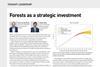
Forests as a strategic investment
Wood is an important economic resource. Due to the growing middle class worldwide, there is increasing structural demand for wood. In this context, forests are becoming an attractive investment, ensuring long-term strategic access to wood in times of geopolitical uncertainty.
-
 White papers
Nordic timberland as a strategic investment
As timberland becomes a core component of institutional real asset portfolios, allocators increasingly face a relative choice: not whether to own forests, but which type of forest exposure best serves long-term capital
-
 White papers
Journey to the Center of Additionality
Roughly 1½ years ago | visited forests in the Northern part of Finland with a client. After walking for just a quarter of an hour we saw two grouses, a hare, and heard plenty of birds singing. Suddenly our guests spoke out: “there is so much more biodiversity here compared to our planted forests.”