

Content (185)
-
 White papers
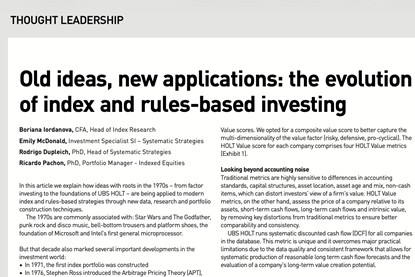
Old ideas, new applications: the evolution of index and rules-based investing
In this article we explain how ideas with roots in the 1970s – from factor investing to the foundations of UBS HOLT – are being applied to modern index and rules-based strategies through new data, research and portfolio construction techniques.
-
 White papers
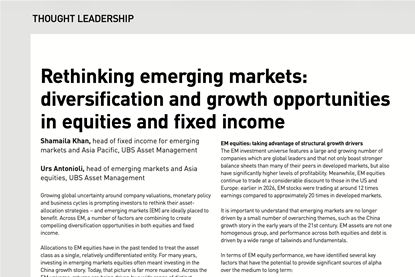
Rethinking emerging markets: diversification and growth opportunities in equities and fixed income
Growing global uncertainty around company valuations, monetary policy and business cycles is prompting investors to rethink their asset-allocation strategies – and emerging markets (EM) are ideally placed to benefit. Across EM, a number of factors are combining to create compelling diversification opportunities in both equities and fixed income.
-
 White papers
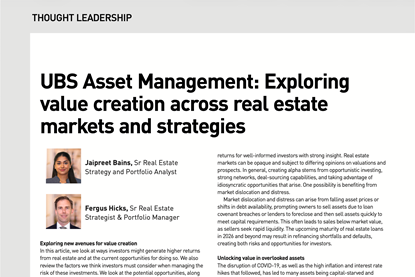
UBS Asset Management: Exploring value creation across real estate markets and strategies
In this article, we look at ways investors might generate higher returns from real estate and at the current opportunities for doing so. We also review the factors we think investors must consider when managing the risk of these investments.
-
 White papers
Markets look past the noise
The investment environment in 2026 continues to be shaped by geopolitical uncertainty, evolving inflation dynamics and the accelerating impact of artificial intelligence (AI). Renewed tensions in the Middle East have reintroduced inflation risks through higher energy prices, while AI-related spending is creating upward pressure on inflation in some sectors. As a result, central banks are expected to maintain restrictive policy settings for longer than previously anticipated.
-
 White papers
Private markets: The Red Thread – Alternatives, mid-year edition 2026
Active portfolio management in uncertain times
-
 White papers
Hedge funds: The Red Thread – Alternatives, mid-year edition 2026
2Q26 outlook - The conflict in the Middle East and subsequent closure of the Strait of Hormuz are shifting the global economy from a ‘goldilocks’ state (steady growth and falling inflation) towards stagflation (lower growth and rising inflation). The recent rebound in risk assets, albeit welcome, may prove short-lived; supply chain disruptions are underway as energy prices and shipping costs rise and global inventories are depleted.
-

-
 White papers
Private equity: The Red Thread – Alternatives, mid-year edition 2026
Private equity returns had a strong quarter, with steady fundamental performance during a turbulent 1H26 that contained several surprises. Artificial intelligence (AI) fears weighed on software valuations in private equity (PE) portfolios, as funds scrambled to assess the threat of AI to business models. Public software valuations continue to face pressure in AI‑exposed segments, although the market is becoming more perceptive to business model differences. This repricing in public markets increases the risk of delayed spillover effects on private software valuations.
-
 White papers
EM corporate debt: A misunderstood asset class
Emerging market corporate debt is a largely misunderstood asset class as general perceptions have not kept up with reality. Our Emerging Markets Fixed Income team looks at how the asset class has evolved over recent years and dispels some of the key myths surrounding it.
-
 White papers
Let your bonds work smarter
Active management can turn fixed income into a more purposeful allocation
-
 White papers
Unified Global Alternatives – Hedge Fund Bulletin: January 2026
Global markets delivered broadly positive performance in January, supported by improving risk sentiment amid elevated sector rotation, higher dispersion, the start of the corporate earnings season, and the nomination of the next US Federal Reserve chair.
-
 White papers
The power of co-investment
Roundtable with Thomas Roche-Toussaint and other industry experts on co-investments with Private Equity International