
Content (34)
-
 White papers
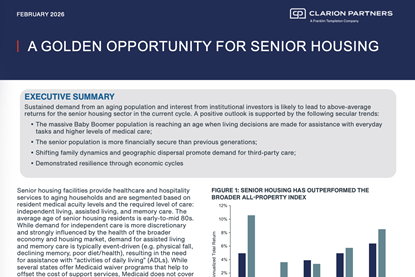
A Golden Opportunity for Senior Housing
Senior housing facilities provide healthcare and hospitality services to aging households and are segmented based on resident medical acuity levels and the required level of care: independent living, assisted living and memory care. The average age of senior housing residents is in the early-to-mid 80s.
-
 White papers
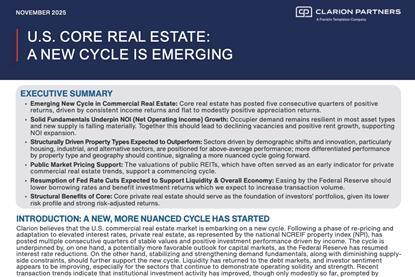
U.S. Core Real Estate: A New Cycle Is Emerging
Clarion believes that the U.S. commercial real estate market is embarking on a new cycle. Following a phase of re-pricing and adaptation to elevated interest rates, private real estate, as represented by the national NCREIF property index (NPI), has posted multiple consecutive quarters of stable values and positive investment performance driven by income. The cycle is underpinned by, on one hand, a potentially more favorable outlook for capital markets, as the Federal Reserve has resumed interest rate reductions. On the other hand, stabilizing and strengthening demand fundamentals, along with diminishing supply-side constraints, should further support the new cycle. Liquidity has returned to the debt markets, and investor sentiment appears to be improving, especially for the sectors that continue to demonstrate operating solidity and strength.
-
 White papers
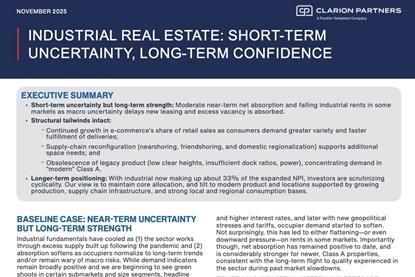
Industrial Real Estate: Short‑Term Uncertainty, Long‑Term Confidence
Industrial fundamentals have cooled as the sector works through excess supply built up following the pandemic and absorption softens as occupiers normalize to long-term trends and/or remain wary of macro risks. While demand indicators remain broadly positive and we are beginning to see green shoots in certain submarkets and size segments, headline rents are declining in some key markets, including Southern California. These market dynamics are raising questions among investors, especially as industrial now represents the largest portion of diversified indices (the expanded NPI’s allocation is ~33% as of 2Q 2025).
-
 White papers
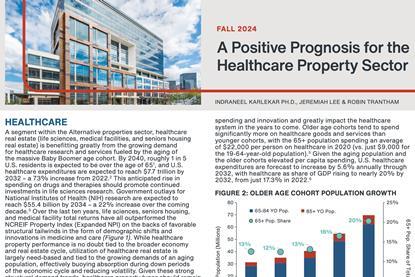
A Positive Prognosis for the Healthcare Property Sector
A segment within the Alternative properties sector, healthcare real estate (life sciences, medical facilities, and seniors housing real estate) is benefitting greatly from the growing demand for healthcare research and services fueled by the aging of the massive Baby Boomer age cohort.
-
 White papers
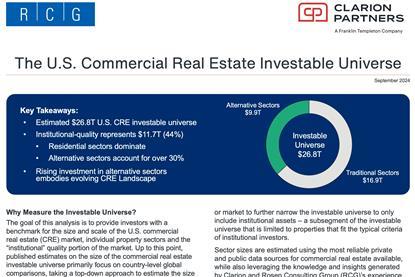
U.S. Commercial Real Estate Investable Universe Study
The goal of this analysis is to provide investors with a benchmark for the size and scale of the U.S. commercial real estate (CRE) market, individual property sectors and the “institutional” quality portion of the market. Up to this point, published estimates on the size of the commercial real estate investable universe primarily focus on country-level global comparisons, taking a top-down approach to estimate the size of the overall commercial real estate market in each region.
-
 White papers
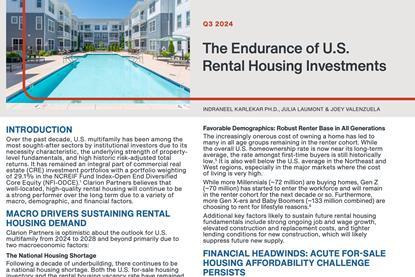
The Endurance of U.S. Rental Housing Investments
Over the past decade, U.S. multifamily has been among the most sought-after sectors by institutional investors due to its necessity characteristic, the underlying strength of property-level fundamentals, and high historic risk-adjusted total returns.
-
 White papers
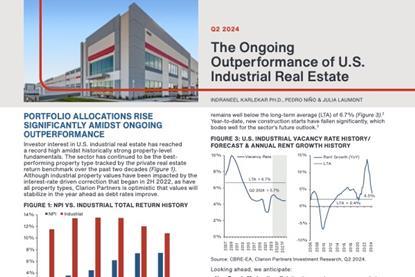
The Ongoing Outperformance of U.S. Industrial Real Estate
Investor interest in U.S. industrial real estate has reached a record high amidst historically strong property-level fundamentals. The sector has continued to be the best-performing property type tracked by the private real estate return benchmark over the past two decades.
-
 White papers
Prioritizing DC Plan Participant Outcomes with Private Real Estate
Most retirement plan sponsors and fiduciaries design well-thought-out, diversified portfolios for retirement plan participants. However, in comparing U.S. defined benefit (DB) and defined contribution (DC) plans, we notice differences in private asset allocations, in particular, to private real estate, despite both plan types seeking to solve for the same goal: income replacement in retirement.
-
 White papers
Five Structural Themes Driving Real Estate Investment
Commercial real estate demand and performance are driven by cyclical and structural factors. Cyclical factors, such as interest rates, consumer spending and employment, vary with economic cycles.
-
 White papers
The Sun Belt’s Ongoing Boom
The ongoing and rapid growth in the U.S. Sun Belt has been an extraordinary boon to commercial real estate investors.
-
 White papers
The Case for U.S. & EU Industrial Real Estate
The industrial sector has become a global favorite amongst institutional investors as large structural shifts already underway, accelerated during the pandemic.
-
 White papers
The Endurance of U.S. Rental Housing Investments
Over the past decade, U.S. multifamily has been among the most sought-after sectors by institutional investors due to its necessity characteristic, the underlying strength of property-level fundamentals, and high historic risk-adjusted total returns. It has remained an integral part of commercial real estate (CRE) investment portfolios with a portfolio weighting of 29.2% in the NCREIF Fund Index-Open End Diversified Core Equity (NFI-ODCE).